Articles for Kids About How Your Bones Fuse When You Are a Baby
Think back to terminal Halloween for a minute. Wherever you looked, there were vampires, ghosts, or bony skeletons grinning dorsum at you. Vampires and ghosts don't actually be, but skeletons sure do!
Every single person has a skeleton made up of many basic. These basic requite your body structure, allow you lot movement in many ways, protect your internal organs, and more.
It's time to expect at all your bones — the adult human being body has 206 of them!
What Are Bones Made Of?
If you've ever seen a real skeleton or fossil in a museum, y'all might recall that all bones are dead. Although bones in museums are dry, hard, or crumbly, the bones in your body are different. The basic that make up your skeleton are all very much alive, growing and changing all the fourth dimension like other parts of your body.
Most every bone in your torso is fabricated of the same materials:
- The outer surface of bone is called the periosteum (say: pare-ee-OSS-tee-um). It's a thin, dense membrane that contains nerves and claret vessels that nourish the bone.
- The side by side layer is made up of compact bone. This part is smooth and very difficult. It'south the part you run across when you look at a skeleton.
- Within the meaty os are many layers of cancellous (say: KAN-sell-the states) bone, which looks a bit like a sponge. Cancellous bone is not quite as hard as compact os, but information technology is still very strong.
- In many basic, the cancellous bone protects the innermost part of the bone, the bone marrow (say: MAIR-oh). Bone marrow is sort of like a thick jelly, and its job is to brand blood cells.
P
How Bones Abound
When you were a baby, you lot had tiny hands, tiny feet, and tiny everything! Slowly, every bit you grew older, everything became a bit bigger, including your bones.
A baby's trunk has nigh 300 bones at nascence. These eventually fuse (grow together) to grade the 206 bones that adults have. Some of a baby's bones are fabricated entirely of a special textile called cartilage (say: KAR-tel-ij). Other basic in a baby are partly fabricated of cartilage. This cartilage is soft and flexible. During babyhood, as you are growing, the cartilage grows and is slowly replaced by bone, with help from calcium.
By the time you are about 25, this process will be consummate. After this happens, there tin be no more growth — the bones are as big as they will ever exist. All of these bones brand upwardly a skeleton that is both very strong and very light.
Your Spine
Your spine is one function of the skeleton that'due south easy to cheque out: Achieve effectually to the heart of your back and you lot'll experience its bumps under your fingers.
The spine lets you twist and bend, and it holds your body upright. It also protects the spinal cord, a big package of nerves that sends data from your encephalon to the rest of your body. The spine is special because information technology isn't made of ane or even two basic: It'south made of 33 bones in all! These bones are called vertebrae (say: VER-tuh-bray) and each one is shaped like a ring.
There are different types of vertebrae in the spine and each does a dissimilar kind of job:
- The first seven vertebrae at the pinnacle are chosen the cervical (say: SIR-vih-kul) vertebrae. These bones are in the back of your neck, just beneath your brain, and they support your caput and cervix. Your caput is pretty heavy, so it's lucky to have help from the cervical vertebrae!
- Below the cervical vertebrae are the thoracic (say: thuh-RAS-ik) vertebrae, and there are 12 in all. These guys ballast your ribs in identify. Below the thoracic vertebrae are five lumbar (say: LUM-bar) vertebrae. Beneath the lumbar vertebrae is the sacrum (say: SAY-krum), which is made up of 5 vertebrae that are fused together to class i single bone.
- Finally, all the style at the lesser of the spine is the coccyx (say: COK-siks), which is one bone fabricated of four fused vertebrae. The bottom sections of the spine are important when it comes to bearing weight and giving y'all a good eye of gravity. So when y'all pick up a heavy backpack, the lumbar vertebrae, sacrum, and coccyx give yous the power. When you dance, skip, and fifty-fifty walk, these parts help keep y'all balanced.
In between each vertebra (the proper name for just ane of the vertebrae) are modest disks made of cartilage. These disks keep the vertebrae from rubbing against one another, and they as well act as your spine's natural shock absorbers. When y'all bound in the air, or twist while slamming a dunk, the disks give your vertebrae the cushioning they need.
P
Your Ribs
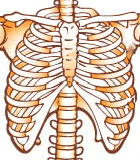
Your eye, lungs, and liver are all very of import, and luckily yous've got ribs to continue them safe. Ribs act like a muzzle of bones around your breast. Information technology's easy to feel the lesser of this cage past running your fingers along the sides and front of your torso, a few inches beneath your heart. If you breathe in deeply, yous can easily feel your ribs right in the front of your body, too. Some thin kids tin even see a few of their ribs right through their pare.
Your ribs come in pairs, and the left and correct sides of each pair are exactly the aforementioned. Almost people accept 12 pairs of ribs, simply some people are born with one or more than extra ribs, and some people might have one pair less.
All 12 pairs of ribs attach in the back to the spine, where they are held in place by the thoracic vertebrae. The first vii pairs of ribs attach in the front end to the sternum (say: STUR-num), a strong bone in the eye of your chest that holds those ribs in place. The remaining sets of ribs don't adhere to the sternum directly. The next three pairs are held on with cartilage to the ribs above them.
The very terminal two sets of ribs are called floating ribs because they aren't connected to the sternum or the ribs higher up them. But don't worry, these ribs can't ever float away. Like the rest of the ribs, they are deeply attached to the spine in the back.
Your Skull
Your skull protects the most important part of all, the brain. You can experience your skull by pushing on your head, peculiarly in the back a few inches above your cervix. The skull is really made up of different bones. Some of these basic protect your brain, whereas others make up the construction of your face. If you touch beneath your optics, yous tin feel the ridge of the bone that forms the pigsty where your eye sits.
And although y'all can't encounter it, the smallest bone in your whole body is in your head, too. The stirrup bone behind your eardrum is but .i to .13 inches (two.v to 3.3 millimeters) long! Want to know something else? Your lower jawbone is the only bone in your head you can move. It opens and closes to let you talk and chew food.
Your skull is pretty cool, but it's changed since yous were a baby. All babies are built-in with spaces between the basic in their skulls. This allows the bones to move, shut up, and even overlap equally the baby goes through the birth canal. Equally the baby grows, the space between the basic slowly closes upward and disappears, and special joints called sutures (say: SOO-churs) connect the bones.
p
Your Hands

Every bit you sit and type at the keyboard, while you swing on a swing, even when you choice upward your lunch, y'all're using the bones in your fingers, hand, wrist, and arm.
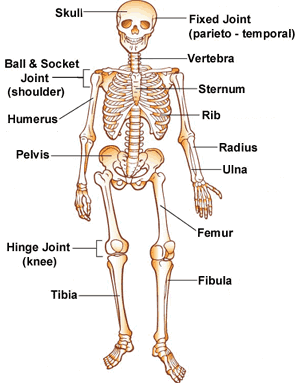
Each arm is fastened to a shoulder blade or scapula (say: SKA-pyuh-luh), a large triangular bone on the upper dorsum corner of each side of the ribcage. The arm is fabricated up of 3 bones: the humerus (say: HYOO-muh-rus), which is to a higher place your elbow, and the radius (say: RAY-dee-united states) and ulna (say: UL-nuh), which are below the elbow.
Each of these bones is wider at the ends and skinnier in the middle, to help requite it strength where it meets another bone. At the end of the radius and ulna are eight smaller bones that make upwards your wrist. Although these bones are small, they can really motility! Twist your wrist around or wave and you'll see how the wrist can move.
The center role of your manus is made upward of five divide bones. Each finger on your hand has 3 basic, except for your thumb, which has two. And so between your wrists, hands, and all your fingers, y'all've got a one thousand full of 54 bones — all ready to aid yous grasp things, write your proper name, pick upwardly the phone, or throw a softball!
Your Legs
Sure, your arm, wrist, paw, and finger bones are cracking for picking up the telephone, just how are you supposed to run to answer it? Well, with the bones of the legs and feet!
Your legs are attached to a round grouping of bones called your pelvis. The pelvis is a basin-shaped structure that supports the spine. It is made up of the ii large hip bones in front, and behind are the sacrum and the coccyx. The pelvis acts as a tough ring of protection around parts of the digestive organization, parts of the urinary system, and parts of the reproductive system.
Your leg bones are very large and strong to help support the weight of your body. The bone that goes from your pelvis to your knee joint is called the femur (say: FEE-mur), and it's the longest bone in your body. At the knee, there'south a triangular-shaped os chosen the patella (say: puh-TEL-luh), or kneecap, that protects the human knee. Below the human knee are two other leg bones: the tibia (say: TIH-bee-uh) and the fibula (say: FIH-byuh-luh). Just like the three bones in the arm, the iii bones in the leg are wider at the ends than in the heart to give them forcefulness.
The ankle is a bit different from the wrist; it is where the lower leg bones connect to a big bone in the foot called the talus (say: TAL-iss). Next to the talus are six other bones. Merely the main part of the human foot is like to the mitt, with v bones. Each toe has 3 tiny bones, except for your big toe, which has just ii. This brings the os total in both anxiety and ankles to 52!
About people don't apply their toes and feet for grabbing stuff or writing, but they do apply them for two very of import things: standing and walking. Without all the basic of the human foot working together, it would exist impossible to residuum properly. The bones in the feet are bundled so the pes is most flat and a bit broad, to help you stay upright. So the adjacent fourth dimension you're walking, be sure to look down and thank those toes!
P
Your Joints
The place where 2 basic run across is called a joint. Some joints move and others don't.
Fixed joints are stock-still in identify and don't move at all. Your skull has some of these joints (called sutures, remember?), which close upward the bones of the skull in a immature person'southward caput. One of these joints is called the parieto-temporal (say: par-EYE-ih-toh TEM-puh-rul) suture — it'due south the 1 that runs along the side of the skull.
Moving joints are the ones that allow yous ride your bicycle, eat cereal, and play a video game — the ones that let you to twist, bend, and move different parts of your body. Some moving joints, like the ones in your spine, move but a piffling. Other joints motility a lot. Ane of the main types of moving joints is called a hinge articulation. Your elbows and knees each have hinge joints, which let you bend and so straighten your artillery and legs. These joints are similar the hinges on a door. Merely as most doors can only open one manner, y'all tin only bend your artillery and legs in one direction. You also have many smaller hinge joints in your fingers and toes.
Another important blazon of moving joint is the ball and socket joint. You can find these joints at your shoulders and hips. They are fabricated up of the circular finish of one bone plumbing fixtures into a small loving cup-similar area of some other bone. Ball and socket joints permit for lots of movement in every direction. Make sure you've got lots of room, and attempt swinging your arms all over the place.
Have you lot always seen someone put oil on a swivel to make it work easier or stop squeaking? Well, your joints come with their own special fluid called synovial fluid (say: SIH-no-vee-ul) that helps them motility freely. Bones are held together at the joints past ligaments (say: LIH-guh-mints), which are like very strong rubber bands.
Taking Care of Bones
Your bones help you lot out every solar day so make sure you accept intendance of them. Hither are some tips:
Protect those skull bones (and your brain inside!) by wearing a helmet for bike riding and other sports. When you lot use a skateboard, in-line skates, or a scooter, exist sure to add wrist supports and elbow and knee joint pads. Your basic in these places will cheers if you have a fall!
If yous play sports like football, soccer, lacrosse, or ice hockey, ever wear all the correct equipment. And never play on a trampoline. Many kids end up with broken bones from jumping on them. Broken bones can eventually heal, merely information technology takes a long time and isn't much fun while y'all wait.
Strengthen your skeleton past drinking milk and eating other dairy products (like low-fat cheese or frozen yogurt). They all comprise calcium, which helps bones harden and become potent.
Be active! Another fashion to strengthen your basic is through do like running, jumping, dancing, and playing sports.
Take these steps to be good to your basic, and they will treat you right!
Articles for Kids About How Your Bones Fuse When You Are a Baby
Source: https://kidshealth.org/en/kids/bones.html
0 Response to "Articles for Kids About How Your Bones Fuse When You Are a Baby"
Post a Comment