Funny Games 1997 English Subtitles Watch Online
| Funny Games | |
|---|---|
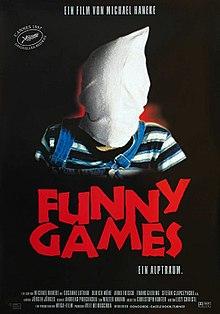 Original release poster | |
| Directed past | Michael Haneke |
| Written by | Michael Haneke |
| Produced by | Veit Heiduschka |
| Starring |
|
| Cinematography | Jürgen Jürges |
| Edited by | Andreas Prochaska |
| Production | Österreichischer Rundfunk |
| Distributed by | Concorde-Castle Rock/Turner |
| Release dates |
|
| Running time | 109 minutes[2] |
| State | Austria |
| Languages | German French |
Funny Games is a 1997 Austrian psychological thriller film written and directed by Michael Haneke, and starring Susanne Lothar, Ulrich Mühe, and Arno Frisch. The plot involves two immature men who hold a family hostage and torture them with sadistic games in their vacation habitation. The film was entered into the 1997 Cannes Film Festival.[iii] A shot-for-shot remake, filmed and gear up in the The states, was released in 2007, as well directed by Haneke, this time with an English language-speaking cast and a by and large American crew.
Plot [edit]
Georg, his wife Anna, their son Georgie, and their domestic dog Rolfi go far at their holiday dwelling house abreast a lake in Republic of austria. On the drive over, they spot their adjacent-door neighbor Fred accompanied by two young Viennese men whom they exercise not recognize. Fred introduces the men as Peter and Paul, ane of whom Fred claims is the son of a friend.
Shortly after the family settles in, Peter and Paul begin imposing themselves on the family'southward courtesy. First, Peter asks to borrow eggs, which he keeps breaking (supposedly by accident). He also destroys the family'due south phone with his credible awkwardness. Eventually, a frustrated Anna demands that the men go out, asking Georg to eject them from the premises. Peter breaks Georg's leg with the latter'south golf club while Paul reveals he has killed Rolfi, and the two men take the family hostage. Their neighbour Eva and a few friends arrive at the family's dock on a boat. Paul escorts Anna to greet them. Anna lies, stating that Paul is a family friend, and says that Georg is resting, having pulled a musculus while setting up the yacht. Anna tells Eva that they may come over after dinner.
Over the following several hours, Peter and Paul subject the family to sadistic games; Paul demands Anna remove her dress afterward Peter states he would not have sexual practice with her. Paul then covers Georgie'southward caput in a pillowcase, simply Georgie eventually flees to Fred's business firm, which he finds empty. Paul chases later him, cornering him in the business firm. Georgie attempts to shoot him with a shotgun but finds the gun has no ammunition. Paul returns Georgie to the dwelling, bringing the shotgun with him.
Paul asks if the family wants to bet whether they will still exist alive by 9:00 the next morning, though he doubts that they will win. Between playing their games, the two men proceed up a constant blueprint, and Paul frequently ridicules Peter's weight and lack of intelligence. He relates contradictory stories of Peter'southward past. No definitive explanation of the men's origins or motives is offered. Afterwards a few more games, Peter plays a counting-out game betwixt the family unit members and shoots Georgie while Paul makes sandwiches in the kitchen. After this, both intruders leave.
Georg and Anna weep for their loss just eventually resolve to survive. Anna flees the house while Georg, with a broken leg, tries to repair the malfunctioning phone. Anna struggles to detect help, but somewhen, Peter and Paul reappear, capture her, and return to the business firm. During some other sadistic game, Anna grabs the discarded shotgun and kills Peter; even so, Paul uses a remote control to rewind the film, breaking the 4th wall and prevents this from happening. They kill Georg and take Anna out on the family'south gunkhole early on the side by side morning. Around viii:00, Paul casually pushes the bound Anna into the water to drown, thus winning their bet. Presently after, the men arrive at Eva'south house and knock on the door, request for some eggs.
Bandage [edit]
- Susanne Lothar as Anna Schober
- Ulrich Mühe as Georg Schober
- Stefan Clapczynski as Georg "Georgie" Schober Jr.
- Arno Frisch as Paul
- Frank Giering as Peter
- Christoph Bantzer as Fred Berlinger
- Monika Zallinger equally Eva Berlinger
- Doris Kunstmann as Gerda
- Wolfgang Glück as Robert
Themes [edit]
The flick often blurs the line between fiction and reality, especially highlighting the act of ascertainment. The character Paul breaks the quaternary wall throughout the pic and addresses the camera in various means. Equally he directs Anna to look for her dead dog, he turns, winks, and smirks at the photographic camera. When he asks the family to bet on their survival, he turns to the photographic camera and asks the audience whether they volition bet every bit well. At the stop of the moving picture, when requesting eggs from the next family, he looks into the photographic camera and smirks again. Merely Paul breaks the fourth wall in the moving-picture show, while Peter makes references to the formulaic suspense rules of traditional cinema throughout the picture.[ citation needed ]
Paul also oftentimes states his intentions to follow the standards of moving-picture show plot development. When he asks the audience to bet, he guesses that the audience wants the family to win. After the killers vanish in the third human action, Paul later explains that he had to give the victims a final chance to escape or else it would not be dramatic. Toward the end of the film, he postpones killing the remainder of the family considering the pic has not nonetheless reached feature length. Throughout the film, Paul shows awareness of the audience'south expectations.
Nonetheless, Paul also causes the film to go against convention on a number of occasions. In thrillers, one protagonist that the audience tin sympathise with usually survives, but hither all three family members dice. When Anna successfully shoots Peter, every bit a possible first to a heroic escape for the family, Paul uses a remote control to rewind the moving picture itself and prevent her action. Afterwards Peter shoots Georgie, Paul scolds him for killing the child showtime because information technology goes against convention and limits the suspense for the remainder of the pic. At the stop of the film, the murderers foreclose Anna from using a knife in the boat to cut her bonds. An earlier shut-up had pointed out the knife'southward location equally a possible set-up for a final-deed escape, only this becomes a ruddy herring. At the end of the pic, Paul once more smirks triumphantly at the audience. As a self-aware character, he is able to go against the viewers' wishes and make himself the winner of the film.
Subsequently killing Anna, Peter and Paul fence about the line between reality and fiction. Paul believes that a fiction that is observed is simply as real equally annihilation else, but Peter dismisses this thought. Unlike Paul, Peter never shows an sensation that he is in a film.
Haneke states that the unabridged motion picture was not intended to be a horror pic. He says he wanted to brand a message about violence in the media by making an incredibly violent, but otherwise pointless picture. He had written a short essay revealing how he felt on the issue, chosen "Violence + Media." The essay is included as a chapter in the volume A Companion to Michael Haneke. [4]
Film scholar Brigitte Peucker argues that the film functions to "assault the spectator," calculation: "On the surface, Funny Games appears to exemplify what Stephen Prince's idea of responsibly filmmaking... but, by means of modernist strategies such every bit the direct await out of the frame, information technology establishes a complicity between the film's spectators and the murderers depicted in its narrative. Information technology takes, therefore, an aggressive—not to say sadistic—posture toward its audition."[5]
Production [edit]
Haneke wanted to make a picture set in the United States, but for practical reasons he had to set it in Austria.[6]
After the 2007 American remake directed by Haneke used the same house including props and tones, Robert Koehler of Cineaste wrote that this "proves for certain that—whether he uses the neat cinematographer Jürgen Jürges (for the 1997 version) or the great Darius Khondji (for the new picture show)—Haneke is fundamentally his own cinematographer exercising considerable command over the entire look of his films."[6]
Critical response [edit]
Austrian critics argued that the intention was to undermine the heimat genre and its values, which are conservative and based on the home. European and English language-language critics, according to Robert Koehler of Cineaste, "generally set their criticism against the backdrop of the American slasher motion-picture show that the movie was subverting" and "expressed mild forms of outrage forth with admiration".[6] In an interview, the film director and critic Jacques Rivette made his displeasure with the film clear, calling information technology "a disgrace", "vile", and "a complete slice of shit."[7] When kickoff shown at the 1997 Cannes Film Festival one-third of the audition had walked out by the end of the film.[8]
On Rotten Tomatoes the film has an approving rating of 69% based reviews from 36 critics, with an average rating of 7/10. The site'southward critical consensus states: "Violent images and blunt audience provocation make up this nihilistic experiment from one of cinema'south more difficult filmmakers".[9] On Metacritic the motion-picture show has a score of 69 out of 100 based on reviews from x critics, indicating "generally favorable reviews".[10]
Variety 'south David Rooney wrote: "the film is shocking and upsetting, but never truly gets nether the skin the way this kind of material often can. Whatever reservations are prompted by Haneke's arroyo, his management is controlled and edgy." Rooney criticized the length of the film, saying information technology "outstays its welcome and is more than than a trivial as well knowing in its manipulation of standard audience expectations for the genre."[11]
Dwelling media [edit]
On xiv May 2019, the picture show was released on DVD and Blu-ray as office of the Benchmark Collection.[12]
American remake [edit]
An American remake of the aforementioned name was released in 2007. Information technology stars Tim Roth, Michael Pitt, Brady Corbet, and Naomi Watts, and is also written and directed by Michael Haneke.[13]
Come across too [edit]
- Listing of films featuring home invasions
References [edit]
- ^ "Funny Games (1997)". AllMovie. Archived from the original on 27 May 2019. Retrieved 27 May 2019.
- ^ "Funny Games (18)". British Board of Film Nomenclature. thirteen March 1998. Retrieved 29 May 2013.
- ^ "Festival de Cannes: Funny Games". festival-cannes.com. Archived from the original on 10 July 2011. Retrieved 21 September 2009.
- ^ Haneke, Michael (2010). "Violence and the Media". In Roy Grundmann (Ed.), A Companion to Michael Haneke, pp. 575–579. Chichester, West Sussex: Wiley-Blackwell. ISBN 978-1-4051-8800-5
- ^ Peucker 2007, p. 142.
- ^ a b c Koehler, Robert. "Funny Games." (Archive) Cineaste. Retrieved on 12 October 2013.
- ^ Bonnaud, Frédéric (25 March 1998). "The Captive Lover - An Interview with Jacques Rivette". Senses of Cinema. Retrieved 7 Nov 2014.
- ^ Johnston, Sheila (8 June 2009). "Palme d'Or winner Michael Haneke: roughshod to his characters and to u.s.".
A stupor-sensation in Cannes, where it provoked mass walkouts
- ^ "Funny Games". Rotten Tomatoes. eleven March 1998. Retrieved 24 May 2021.
- ^ "Funny Games". Metacritic . Retrieved 10 Jan 2020.
- ^ Rooney, David (25 May 1997). "Funny Games". Variety.
- ^ Funny Games at Benchmark.com
- ^ Gleiberman, Owen (12 March 2008). "Funny Games". Entertainment Weekly . Retrieved 10 January 2020.
Sources [edit]
- Peucker, Brigitte (2007). The Material Image: Art and the Real in Film. Stanford, California: Stanford Academy Press. ISBN978-0-804-75431-6.
External links [edit]
- Funny Games at IMDb
- Funny Games at Rotten Tomatoes
- Funny Games: Don't You Want to Run into How It Ends? an essay by Bilge Ebiri at the Criterion Collection
Source: https://en.wikipedia.org/wiki/Funny_Games_(1997_film)
0 Response to "Funny Games 1997 English Subtitles Watch Online"
Post a Comment